
Under-Sink Organization: The 10-Minute System That Sticks
The cabinet under your sink is the hardest storage in the house, and it's not close. Every other cabinet is a box. This one has a drain pipe running through the middle of it, a garbage disposal bolted to the ceiling, a shutoff valve in each back corner, and a floor made of particleboard that will swell like a sponge the first time something drips. Then we ask it to hold thirty bottles.
So the reason your under-sink cabinet is a graveyard isn't discipline. It's that you've been organizing it like a cabinet when it's actually a utility closet with plumbing in it. The system below takes about ten minutes, works in a kitchen or a bathroom, and survives — because it's built around the pipes instead of pretending they aren't there.
Doing the whole room? Pair this with 25 small kitchen organization ideas →
The 10-minute system, in order

Minute 1–2: Empty it completely. Everything on the floor. Don't sort yet, don't be clever. You cannot organize around objects you can't see, and half of what's in there is going to leave anyway.
Minute 3: Check for water damage while it's empty. Run your hand over the cabinet floor and the base of the P-trap. Soft spots, dark rings, or a musty smell mean you have a slow leak — fix that before you buy a single bin. This thirty seconds is the most valuable part of the whole project.
Minute 4–5: Cull hard. One bottle per job. Nobody needs three all-purpose sprays, four half-empty glass cleaners, and a specialty product bought for a stain that happened in 2023. Combine duplicates, bin the empties and the expired, and pull out everything that shouldn't be down there at all (more on that in a second).
Minute 6: Lay the mat. Before anything goes back, the waterproof liner goes down. Non-negotiable — see below.
Minute 7–8: Build around the pipe, not against it. The space directly under the drain stays empty; that's your access lane for the day the trap needs a wrench. Put a two-tier or U-shaped organizer on the roomier side, a pull-out basket on the other, and hang your sprays on a tension rod above.
Minute 9–10: Assign four homes and label them. Every under-sink cabinet holds the same four categories: Daily cleaners (the ones you reach for weekly), Deep-clean / occasional, Tools (gloves, sponges, brushes, trash bags), and Refills. If an item doesn't belong to one of the four, it doesn't live here.
What should never live under the sink
This is the list that quietly saves you money. Under-sink cabinets are dark, warm, humid, and occasionally wet. So keep out: paper goods (they wick water), bulk sponges and towels (mildew), pet food (moisture and pests), small appliances (electrical + damp is a bad pairing), and, in the bathroom, anything you put on your face — the humidity under a bathroom sink degrades skincare faster than you'd think.
What should live there: liquid cleaners, dish and dishwasher supplies, trash bags, rubber gloves, scrubbing tools, and a small cleaning caddy. Things that are already waterproof, and things you use standing at the sink.
The gear that makes it stick (1–12)
1. A waterproof under-sink mat (buy this first)
Cabinet floors are usually particleboard with a thin laminate skin. One slow drip and it swells, delaminates, and never goes back. A non-adhesive liner with raised edges catches leaks and detergent drips, wipes clean in seconds, and lifts out when you need to inspect the floor. If you buy exactly one thing from this list, buy the mat — it's the cheapest insurance in your kitchen. See it on Amazon →
2. A silicone mat, if your cabinet is a deep rectangle
Big cabinets (34 x 22 in and up) do better with a large silicone tray than a small liner — full coverage, corner to corner, with a lip that actually holds a spill instead of letting it run to the seam. Trim to fit around the pipe with scissors. See it on Amazon →
3. A two-tier expandable rack that straddles the plumbing
The workhorse. An expandable shelf adjusts around the drain pipe and instantly doubles your vertical storage — because the top half of your under-sink cabinet is currently empty air. Set the shelf height to just clear your tallest bottle, not higher; that wasted inch is where clutter starts. See it on Amazon →
4. Or an adjustable-width version for awkward cabinets
If your pipe is off-center or your disposal eats one corner, a rack that adjusts in both directions is worth the small premium. Measure the clearance between the cabinet floor and the bottom of the trap before you order — that number, not the cabinet width, is the one that determines fit. See it on Amazon →
5. A sliding pull-out basket for the back half
The back of an under-sink cabinet is where products go to be forgotten. A pull-out drawer on runners brings the back row to you instead of making you crouch and reach past the trap. This single change is what makes people actually use the deep-clean products they own. See it on Amazon →
6. A two-tier pull-out, if you want tiers and slides in one
An L-shaped or height-adjustable pull-out gives you the shelf and the drawer in a single unit, notched to clear the pipe. Best for kitchen cabinets deeper than about 16 inches — in a shallow bathroom vanity it'll eat more room than it gives back. See it on Amazon →
7. A tension rod to hang the spray bottles
The best five dollars in home organization. Wedge a spring tension rod across the cabinet a few inches below the top and hang every trigger-spray bottle from it by the neck. The bottles stop tipping, the floor space underneath comes back, and you can see every label at once. See it on Amazon →
8. An over-the-door basket for the stuff you grab daily
The inside of the cabinet door is free storage you're not using. A hanging basket there holds sponges, dish brushes, and the one spray you reach for every day — front and center, no crouching. Check that the door still closes over your tallest item before you load it. See it on Amazon →
9. Clear stackable drawers for the small stuff
Under a bathroom sink especially, the enemy is small loose objects: spare toothbrushes, cotton rounds, razor heads, sample sachets. Small clear drawers stack into the vertical space, keep like with like, and let you see the contents without opening anything. See it on Amazon →
10. A lazy susan for the dead corner
Every under-sink cabinet has one corner you can't reach past the pipe. A nonslip turntable turns that dead zone into rotating storage — put the tall bottles on it, spin, done. Pick one that fits past the trap, which usually means 11–14 inches rather than the 18-inch pantry size. See it on Amazon →
11. A collapsible trash bin on the cabinet door
A folding mini bin on the inside of the door catches the compost scraps, the produce stickers, and the drain hair — the little waste that otherwise gets carried across the room or, worse, left on the counter. Renter-friendly: it hooks over the door, no drilling. See it on Amazon →
12. Adhesive hooks for gloves, rags, and the dust pan
Two or three no-drill hooks on the cabinet's side wall — the vertical surface nobody ever uses — hold rubber gloves, a hanging rag, and the little brush-and-pan set. Wipe the wall with alcohol before sticking or they'll fall in a week. See it on Amazon →
Two upgrades that make it a system instead of a shelf
13. A cleaning caddy that leaves the cabinet
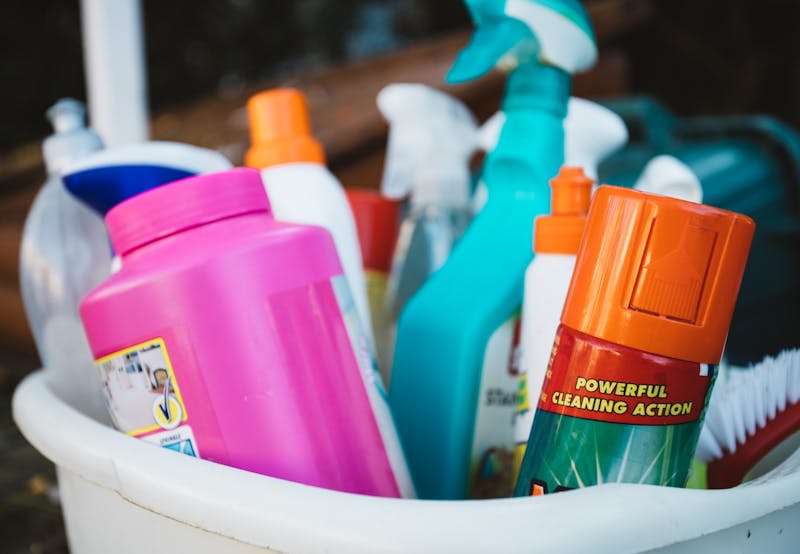
Here's the subtle one. If your cleaners live loose in the cabinet, cleaning day means twelve trips back to the sink. If they live in a caddy with a handle, you pick it up once, clean the whole apartment, and put it back — and because everything returns as a unit, the cabinet stays organized by default. The caddy is what turns storage into a workflow. See it on Amazon →
14. Labels — yes, even in a cabinet nobody sees
Labels aren't decoration; they're instructions for future you (and for anyone else in the house). A label on the front of each bin — Daily · Deep clean · Tools · Refills — is what makes the four homes real. Without them, "put it back" is a judgment call, and judgment calls are how systems collapse. See it on Amazon →
Bathroom vs. kitchen: two small differences
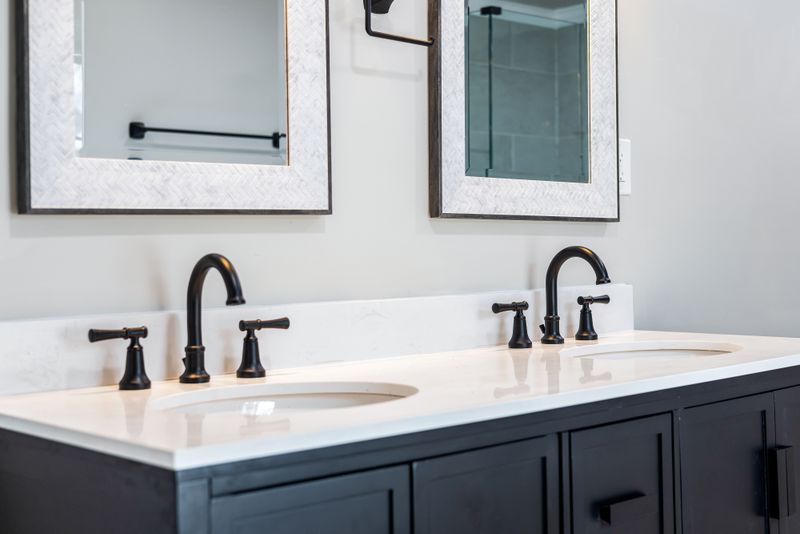
Bathroom vanities are shallower and full of small items, so the ratio flips: fewer big bins, more small clear drawers, and a hard rule that backup toiletries live in a single labeled "refills" box — not spread across the cabinet floor. Humidity is higher too, so nothing cardboard goes in.
Kitchen cabinets are deeper and bottle-heavy, which means pull-outs and turntables earn their keep, and the tension rod does more work. The kitchen cabinet also has the disposal, so measure your usable height in two places — under the disposal and under the trap — because they're rarely the same.
Steal our pantry starter sheets (free)
An aisle-by-aisle grocery list + a ten-minute pantry inventory — the two pages that make a reset actually stick. They're part of our new Small-Space Pantry Bundle (310+ labels + 7 planner pages, $12).
Get the free sheetsThe maintenance rule (60 seconds, not 10 minutes)
Under-sink cabinets don't decay slowly — they collapse the first week you start setting things down instead of putting them away. So the rule is simple: a cleaner goes back to its labeled home the moment you're done with it, and one bottle per job stays the cap forever. Buy a second all-purpose spray, and the system has already started dying.
Do a real reset twice a year — empty, wipe the mat, check the trap for drips, cull the duplicates that snuck in. Ten minutes in July, ten in January. That's the entire ongoing cost of the tidiest cabinet in your home.
Save this for later
Pin this guide to your organization board so it's there on reset day.
Save to PinterestPin these ideas
Tall, save-ready images for your organization boards.


One small-space idea, every Sunday
Join and we’ll send the free pantry starter sheets right away, then one organization idea worth your time each week. No clutter — obviously.
FAQ
- How do I organize under my sink when the pipes are in the way?
- Build around the P-trap rather than fighting it. Use an expandable or U-shaped organizer that straddles the pipe, keep the area directly beneath the drain clear so a plumber (or you) can get a wrench in, and give the deeper side of the cabinet to tall bottles. Hang sprays from a tension rod to reclaim the floor.
- What should you not store under the sink?
- Paper goods, bulk sponges and towels, pet food, small appliances, and — under a bathroom sink — skincare. The cabinet is dark, humid, and one slow leak away from wet. Keep it to liquid cleaners, trash bags, gloves, and scrubbing tools.
- Do I really need an under-sink mat?
- It's the highest-value item in the cabinet. Most cabinet floors are particleboard, which swells permanently once water gets in. A waterproof liner with raised edges catches drips before they reach it and costs a fraction of a cabinet repair.
- How do I keep under-sink organization from falling apart?
- Cap the inputs and label the homes. One bottle per job, backups stored elsewhere, four labeled categories (daily, deep clean, tools, refills), and everything returns to its bin the moment you're done. Cabinets fail when "put it back" becomes a judgment call.
- How much does an under-sink setup cost?
- You can do the whole system with a mat, one expandable rack, a tension rod, and a caddy. Add the pull-out drawer and the door basket later if the cabinet is deep. Buy the mat first, live with the layout for a week, then fill the gaps you actually noticed.