
13 Amazon Kitchen Finds Under $30 Worth the Counter Space

The problem with a small kitchen isn't that you own too much — it's that the space you have is being wasted in ways you stop noticing. The drawer is one deep pile instead of four sorted lanes. The cabinet under the sink is a black hole with a garbage bag and forty inches of unused air above it. The tall cabinet holds two stacked plates and a foot of empty headroom. None of that is a storage shortage; it's a layout that was never set up, and the fix is almost never a renovation. It's a handful of cheap, specific parts that make the space you already own actually reachable.
The trap with "cheap kitchen finds" is that most of them just add another container without adding capacity — a pretty caddy that holds the same clutter, one shelf higher. The ones below are different. Every pick here does one structural job: it divides a drawer into lanes, it stacks a second level into a cabinet, it works around the pipes under the sink, or it clears something off the counter and gives it a home. We kept only products with strong organic review histories on Amazon in 2026, all of them well under $30, and sorted them by the zone they fix. Thirteen finds, grouped by where they go, plus the one rule that keeps a budget reset from turning back into clutter.
Doing a full reset, not just a few finds? Start with our small kitchen organization guide →
Drawers and cabinets — the wasted volume (1–4)
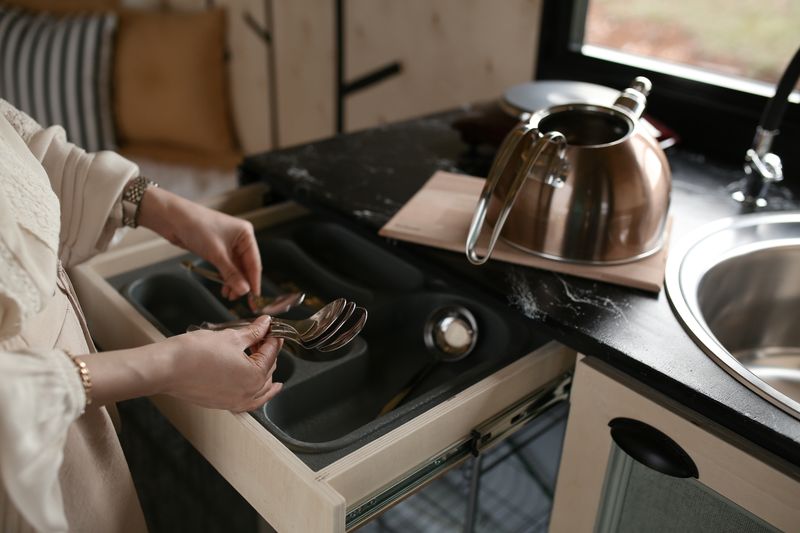
1. Clear drawer organizers to divide the junk drawer
A single deep drawer with everything loose in it is the least efficient storage in the kitchen, because you have to dig through the whole thing to find one peeler. A set of clear, interlocking drawer organizers in mixed sizes turns that pile into sorted lanes — spatulas here, measuring spoons there, the odds and ends contained instead of migrating. The mixed-size sets matter more than a single tray: you fit the bins to the drawer and to what you actually own, and the clear plastic means you never forget what's in the back. Buy the multi-size set and lay it out before you refill. See it on Amazon →
2. A stacking cabinet shelf to use the dead headroom
Most cabinet shelves are set too far apart, so a stack of plates or mugs uses the bottom third and wastes a foot of air above it. A set of two stacking counter-and-cabinet shelves adds a second level right inside the cabinet, so mugs go up top and plates below in the same footprint — instantly doubling what the shelf holds. They work just as well on the counter to lift a row of spice jars or coffee gear off the surface. The pair is the buy: one for the mug cabinet, one for the counter or pantry. See it on Amazon →
3. A three-tier spice rack so nothing hides in the back
Spices stored flat in a cabinet become a back row you can't read and a front row you buy duplicates of. A three-tier stepped spice rack angles every jar up so the whole collection is legible at a glance, drops straight into a cabinet or onto a counter, and stops the daily archaeology of pulling six jars to find cumin. The non-skid version stays put when you grab from it, and the compact fifteen-inch width fits a standard cabinet shelf. Decant nothing, buy nothing else — this alone fixes the most common spice-cabinet failure. See it on Amazon →
4. Magnetic spice jars to move spices off the shelf entirely
If your cabinet has no room for a rack, the answer is to move spices onto a vertical surface you're already ignoring — the side of the fridge or a steel strip on the backsplash. A set of magnetic spice jars with clear windowed lids sticks the whole collection to a vertical surface, freeing the shelf and putting every spice at eye level while you cook. The hexagon jars pack tight without gaps, and the clear top lets you see what's inside without lifting each one. In a small kitchen, using the fridge side is found space you weren't counting. See it on Amazon →
The sink zone — the most-worked, worst-organized square foot (5–8)
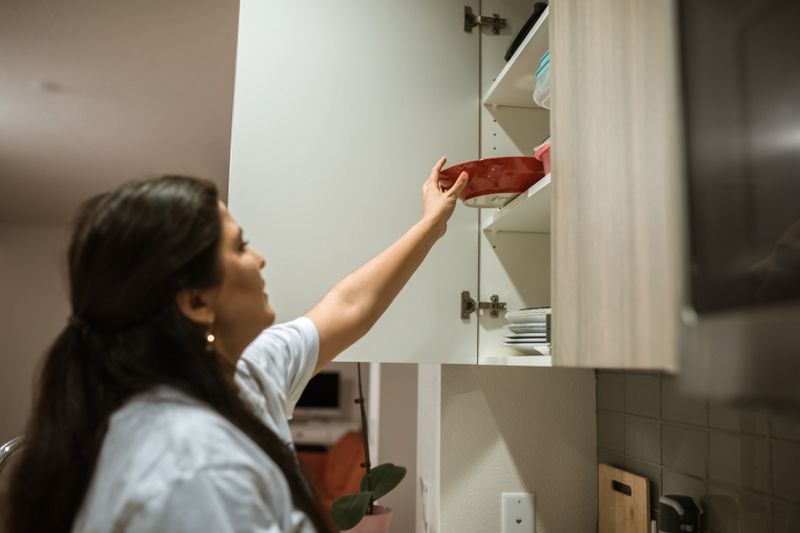
5. A two-tier under-sink organizer built around the pipes
The cabinet under the sink is the most wasted space in the kitchen because the drain pipe cuts through the middle of it, so nobody builds a shelf there and everything ends up in a heap on the floor of the cabinet. A two-tier under-sink organizer with height-adjustable, split shelves works around the plumbing — you set each side to clear the pipe — and turns that cavern into two usable levels for sprays, sponges, and spare bags. The adjustable feet are the whole trick; they let one rack fit a plumbing layout it wasn't measured for. This is the single biggest space reclaim on the list. See it on Amazon →
6. A roll-up dish rack that stores flat
A standing dish rack eats permanent counter space in a kitchen that has none to spare. A roll-up drying rack lays its silicone-wrapped steel rods straight across the sink to drain dishes into the basin, then rolls up and tucks into a drawer when you're done — so the drying zone appears only when you need it and disappears the rest of the time. It doubles as a trivet for hot pots and a rack for rinsing produce. For a small kitchen, the thing that stores flat almost always beats the thing that stands. See it on Amazon →
7. A collapsible colander that flattens to nothing
A rigid colander is a bulky bowl of trapped air that hogs a whole cabinet shelf for a tool you use for two minutes. A collapsible silicone colander does the same job, then folds nearly flat to slide into a drawer or hang on a hook. The over-the-sink handles let it rest across the basin so you can drain pasta one-handed, and the fold-flat design is exactly the kind of trade a small kitchen should make everywhere — full function when open, near-zero footprint when stored. Rinse and it air-dries in the drawer. See it on Amazon →
8. A sink caddy to end the puddle by the faucet
The sponge, the brush, and the dish soap have no home, so they sit in a soggy puddle on the edge of the sink and slime up the counter. A sink caddy that suctions to the basin wall or sits on the counter with a drip tray gives all three a defined spot and lets them drain into the sink instead of onto the surface. It's a two-dollar-feeling fix for a daily annoyance, and keeping the wet stuff contained is what makes the whole sink area read as clean instead of chaotic. Empty the drip tray weekly and it stays fresh. See it on Amazon →
Steal our small-kitchen starter sheets (free)
A one-page counter-clearing checklist + a ten-minute drawer reset plan — the two pages that make a small-kitchen fix actually stick. They're part of our new Small-Space Pantry Bundle (310+ labels + 7 planner pages, $12).
Get the free sheetsThe countertop — clearing the working surface (9–11)
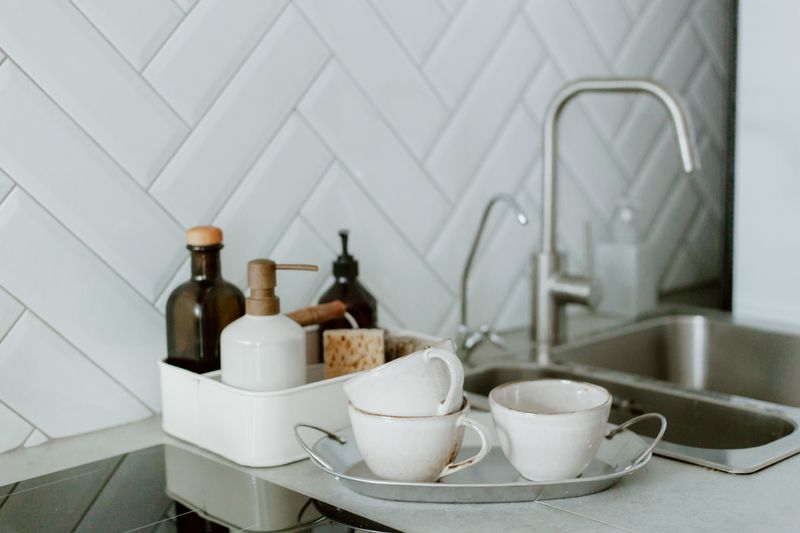
9. A rotating utensil crock to reclaim drawer space
In a small kitchen, the utensils you use every day are better standing on the counter than clogging your one good drawer — as long as they're contained. A rotating acacia-wood utensil holder stands the spatulas and spoons upright in a compact footprint and spins so you grab the right one without digging. Moving the everyday tools to the counter frees a whole drawer for things that actually need to be hidden, and the wood crock reads as intentional rather than cluttered. Keep it to the six tools you reach for daily; the rest go in the drawer you just freed. See it on Amazon →
10. A one-handed paper towel holder to stop the roll from wandering
A loose paper towel roll lives wherever you last set it down, which in a small kitchen is always in the way. A weighted countertop holder that lets you tear a sheet one-handed gives the roll a fixed home and stops the two-handed wrestle that unspools half of it. The heavy base and tension arm are what make the one-handed tear work, and giving the roll a defined spot is a small thing that clears a surprising amount of visual clutter off the counter. Set it near the sink where you actually reach for it. See it on Amazon →
11. A nesting measuring cup and spoon set that stores in one stack
Loose measuring cups and spoons are drawer chaos — different sizes, spoons on a broken ring, cups scattered across two drawers. A stainless steel set that nests into a single stack and clips onto one ring collapses all of it into one small, findable object. Stainless won't stain or warp like the plastic sets, the engraved markings don't rub off in the dishwasher, and the whole set hangs on a single hook if the drawer's full. It's the cheap upgrade that quietly ends a recurring small annoyance. See it on Amazon →
Pantry and fridge — grouping what you can't see (12–13)
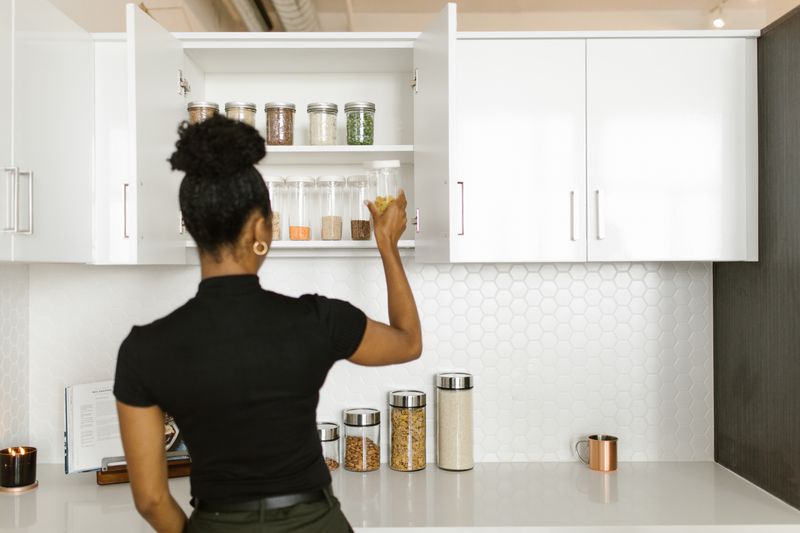
12. Clear pantry bins with handles to make the back reachable
A deep pantry or cabinet shelf uses its front eight inches and hides everything behind them. A set of clear storage bins with handles turns the shelf into a pull-out drawer system — one bin for snacks, one for baking, one for pasta and grains — so you slide out the whole category instead of reaching blindly into the back. Grouping by type is what stops the duplicate buying that happens when you can't see what you already own. Clear sides let you check stock at a glance, and the handles make the back of a deep shelf finally usable. See it on Amazon →
13. Produce containers to stop throwing money in the trash
Most produce doesn't spoil because it's old — it spoils because it's sitting in trapped moisture at the bottom of a crisper. A set of produce storage containers with a raised colander insert and a vented lid lifts berries and greens off the pooled water and lets air move, buying days of extra life on the fastest-rotting food you buy. The leakproof seal means you can stack them, and the clear body keeps the produce visible instead of forgotten behind the milk. This is the rare organizer that pays for itself in food you stop throwing away. See it on Amazon →
How to buy without re-cluttering
The failure mode of a budget kitchen reset isn't spending too much — it's buying organizers for problems you don't have because they looked good in a photo. Every pick on this list earns its place by doing structural work: adding a level, dividing a drawer, working around the pipes, or getting something off the counter and giving it a home. A caddy that just holds the same clutter one shelf higher hasn't added capacity; it's added a container. Before anything goes in the cart, name the specific daily friction it removes. If you can't, skip it.
Then buy in impact order, not all at once. Start with the one spot that annoys you most every single day — usually the dread drawer or the cavern under the sink — because that's where an organizer pays back fastest and proves the approach. Live with that one fix for a week before adding the next, and let the actual bottleneck tell you what to buy rather than ordering a whole kit on faith. Most small kitchens discover that three or four well-placed parts do ninety percent of the work, and the rest of the "must-have" list was never solving a problem they had. Fix the zone in front of you, cook in it for a few days, then decide what's still broken.
Save this for later
Pin this guide to your small-kitchen board so it's there on your next tidy-up.
Save to PinterestPin these ideas
Tall, save-ready images for your organization boards.


One small-space idea, every Sunday
Join and we’ll send the free small-kitchen starter sheets right away, then one organization idea worth your time each week. No clutter — obviously.
FAQ
- What are the best cheap Amazon kitchen organizers for a small kitchen?
- The highest-value cheap picks are the ones that turn dead space into reachable storage: clear drawer organizers to divide a junk-filled drawer, a two-tier under-sink riser that works around the pipes, a stacking cabinet shelf that adds a second level to a tall cabinet, and a roll-up dish rack that rolls out over the sink and stores flat. Each is under $30 and adds usable space without a renovation.
- How do I organize a small kitchen on a budget?
- Work zone by zone and buy only what fixes a specific daily friction. Start with the drawer you dread opening, then the under-sink cavern, then the counter clutter. Skip anything that only looks nice in a photo. The rule that keeps a budget reset from becoming clutter is to buy for a problem you actually have, not a picture you saved.
- Are cheap kitchen organizers worth it?
- Yes, when they solve a structural problem rather than just holding things. A stacking shelf that doubles a cabinet's usable height or a two-tier under-sink rack that works around the plumbing earns its price in reclaimed space immediately. The ones that aren't worth it are the decorative pieces that add a container without adding capacity. Buy for capacity and access, not looks.
- What should I buy first to organize a small kitchen?
- Start with the single spot that annoys you most every day, because that's where an organizer pays back fastest — usually the chaotic utensil drawer or the dead cavern under the sink. Solve one, live with it for a week, then move to the next zone rather than buying everything at once.
- Do I really need matching organizers?
- For anything visible — spice jars, pantry bins — matching footprints sit flush and hold more, so it's worth it there. For hidden spaces like under the sink or inside a drawer, function beats looks: buy the shape that fits the space, matched or not. Save the coordinated look for the shelves you actually see.